John Law, piano; Jon Lloyd, alto/soprano; Tim Wells, bass; Gerry Hemingway, drums.
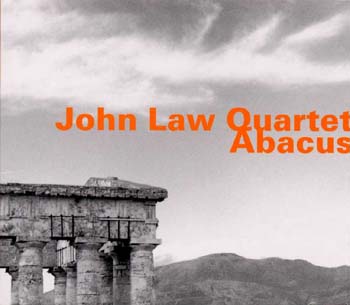

For North Americans, whose familiarity with pianist John Law is primarily, if not exclusively based on the riveting, freely improvised music of his duo with Louis Moholo and Extremely Quartet, Abacus is a minor revelation. Based loosely, but not too loosely on a baroque suite, this "Partita for piano, saxophone, bass and drums" contains a profusion of compositional ideas that meld the flowing cerebral dance of baroque music and the brainy heat of 60's advanced jazz. Law's classical chops are tapped more than in the aforementioned settings, as he hands in several statements that place him closer on a stylistic spectrum to a neo-classicist like Anthony Davis than a maverick like Cecil Taylor. Perhaps most importantly, Law has devised an intriguing ensemble sound for ABACUS (the quartet's name is spelled in caps, while the composition uses only an initial cap) that triggers wildly unlikely associations (imagine a Venn diagram intersecting Dave Brubeck and Greg Osby) in an ultimately vain effort to pigeonhole the music.
Law's knowledge of baroque suite conventions proves to be substantial, making both his adherence to and departures from the form equally pungent. He deftly collects and recasts materials from various sections of the suite like the kernels appropriated from "Burlesque", stripped of their jaunty veneer - to create a viable "Ouverture". Additionally, Law uses the overture to distil the suite's overall brain- and feet-teasing tone, using phrases teeming with capering rhythms and clever cadences. Not only does Law have it right with the slow, dignified triple metre on "Sarabande," but the wispy Spanish tinge as well, as he spins a very seductive theme. And the brisk "Gigue" has the telltale compound metre and fugal writing of the French approach favoured by Bach. Subsequently, when Law strays, as is the case with "Courante," whose running figures and shifting rhythmic feel provide little more than a fig leaf's cover, it registers as well-earned licence.
Law's ensemble meets the varied demands of the suite and substantially shapes the work through their improvisations. Jon Lloyd's lean sound is well-suited for the ensembles; his solos have less of the "unmistakable British sound" Brian Morton identified on Lloyd's By Confusion (hatART, 1996) and are occasionally spiced with M-Basey cool. Tim Wells and Gerry Hemingway prove to be a highly complimentary and provocative team. In the Jarrettish trio section of "Courante" they adroitly let string and cymbal resonances steer the forward rhythmic movement, while their quick-witted banter provides a necessary fulcrum for the open improvisations. It's no surprise, then, that the fine balance of voices within ABACUS has resulted in the fine balance of composition and improvisation on Abacus.

Bill Shoemaker Jazz Review Magazine October 2001